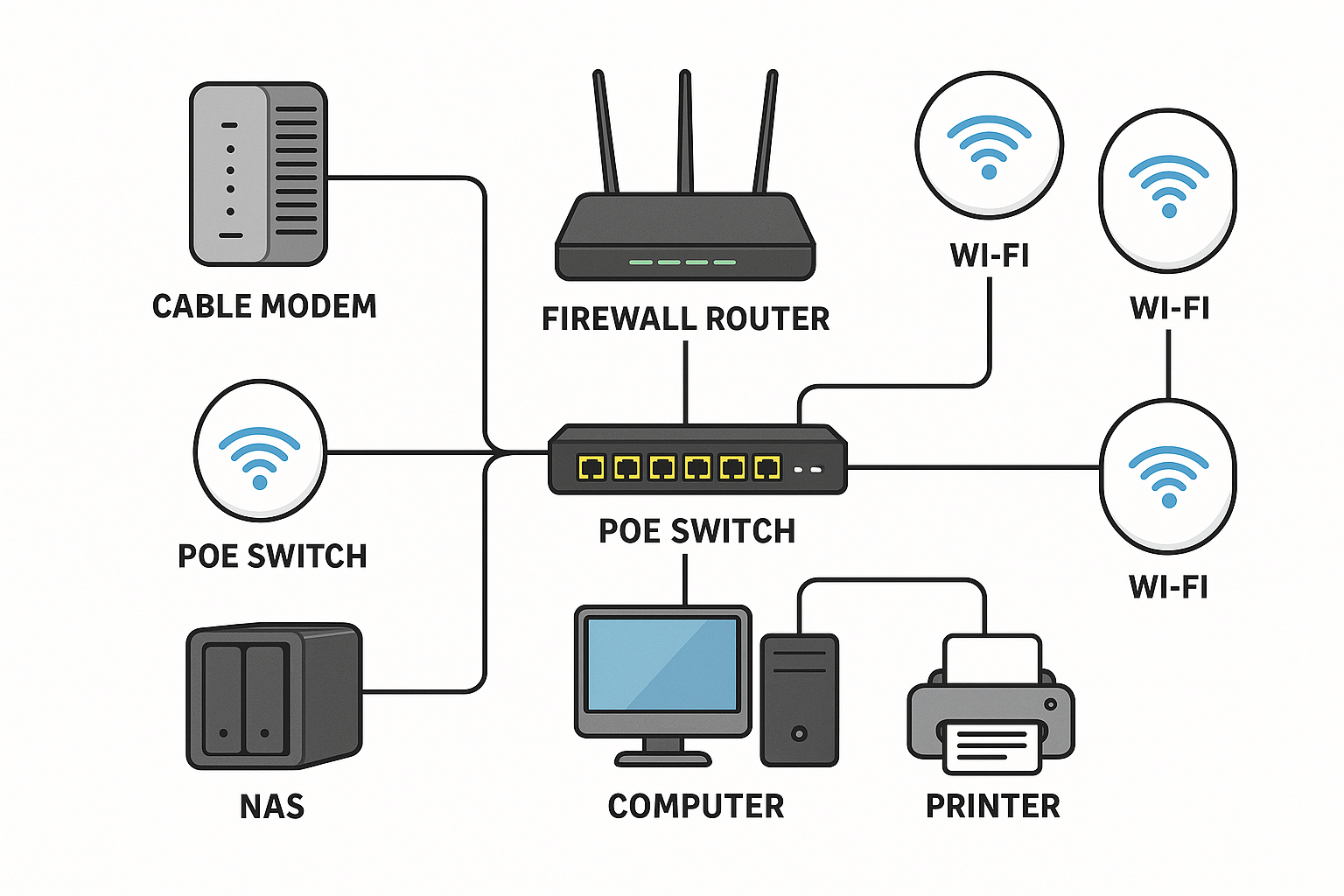

One of the first things you need to consider when starting on your home automation project is the strength of your home network. The home network is the backbone for all your devices and if you have not established an efficient network, your home setup is unlikely to succeed.
Don't Do What I Did
Take if from me, I know. I started about 10 years ago with the purchase of a Nest smart thermostat. Around the same time, I added our first (of 5) Alexa Echo device as a voice assistant. I didn't really give much thought to either security or bandwidth and I just added both devices to the 2.4ghz WiFi, along with all of our other traffic. We actually did not have that much traffic back then - perhaps 4 iPhones, an iPad, and a laptop or two.
Things have changed since then.
A lot!We now have over 40 connected devices including the Alexa devices, Google Nest thermostat, and a plethora of switches, cameras, smart plugs, a kitchen range, and two TVs. We still have three iPhones, an iPad, and three laptops that also run off the network. And things worked for the most part. The Google Nest thermostat (gen 3) worked well with Alexa after setting up the skill. It may have become disconnected over time but it was a simple fix to reset it. In hindsight, I would never buy Google again. First, it has it's own ecosystem. Second, despite trying not to be evil, Google makes decisions based on what is good for Google and their recent abandonment of Nest gen 1 and 2 thermostats left many people out in the cold. Or stuck in the heat, dependingon where they live.
I had not given much choice to the devices that I purchased and was happy if they worked with Alexa. Most do. That creates another problem - disorganization and multiple entries in Alexa for the same device. That became a mess. I found that using Alexa was a mess in general.
So I did what many people do once they learn more, they standardize on one particular tech hub. It could be Alexa, but since I am a fan of Apple, I chose Apple. Which is when I learned that Apple is more network dependent than any of the other hubs. (I will have a separate post later on why I like Apple).
Apple Home Loves a Strong Network
That headline could also read, Apple Home Won't Work on an Average or subpar Network. At least not consistently. When I first started down the Apple road, I immediately began experiencing issues. At first I didn't recognize these as network issues.
It started when I noticed a light on in the living room that should not be on in the morning. It should have been off. There were others in this state as well. I checked the app and was unable to shut them off. They just showed as Not Responding.
I googled it and every instruction started with reboot the router, and reboot your homepod. Every one without fail. I did both of those and nothing - same condition. They I had to go in an re-add all my devices to the Apple Home. That did the trick. At least temporarily. But not for all cases.
I could not get my Logitech Circle doorbell cam to work. And the lights on the outside of the garage never came back. After reviewing the placement of my WiFi access points, I realized that I probably had weak or non-existant coverage to those points. That said, it used to just work with similar WiFi light bulbs in those locations!
Prior to moving to Apple Home, I was using the SmartLife app and Alexa and things had worked great. With Apple Home, not so much. Ugh, now what?
Redesign from the Ground Up
That is when I decided to revise the network from the ground up. After all, the old network had evolved over time and served our needs well. But I had routers and access points that were well over 10 years. It was time to invest in some new gear and bring the network up to date. I also wanted to create separation for all those Internet of Things (IoT) devices to keep them away from our personal devices. This was for both security and performance reasons.
In my next blog post, I will outline the process I followed. There was a lot of trial and error and my hope is that you can avoid some of the errors I made in designing your own network setup.